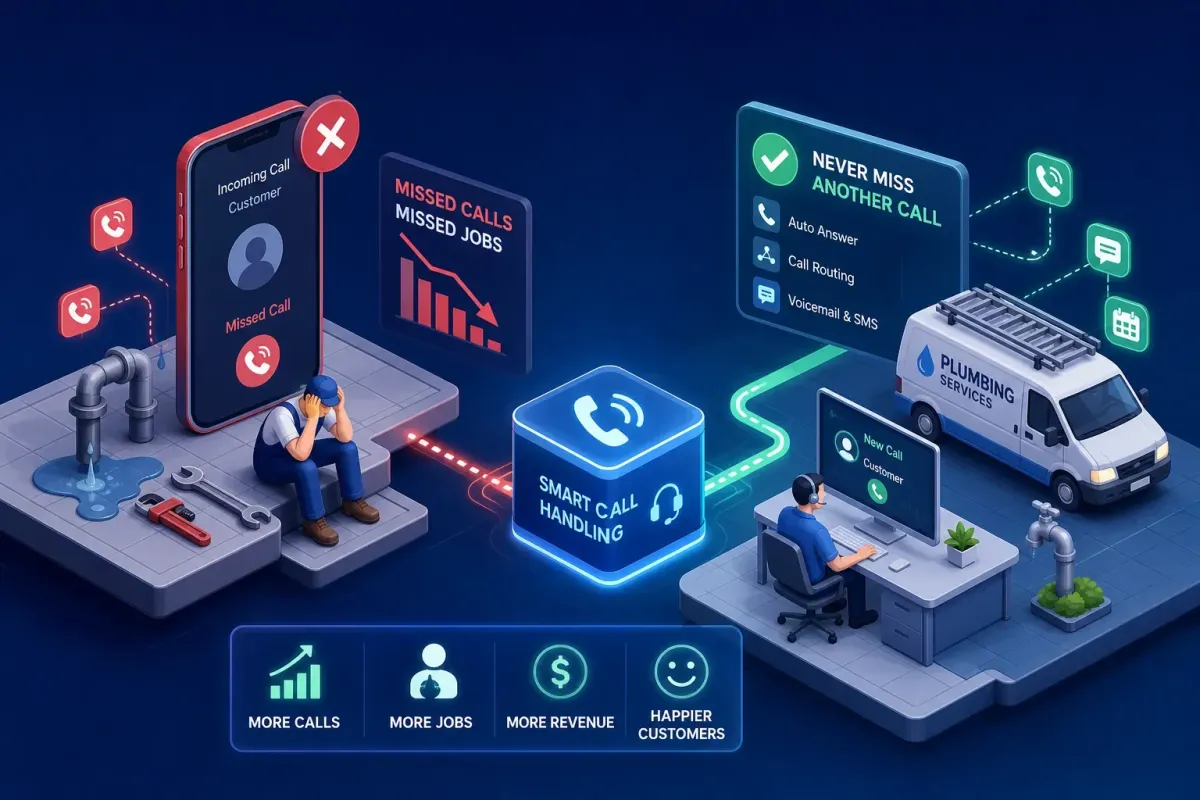
How to Stop Missing Customer Calls as a Plumber
Stop Missing Customer Calls: The Plumber's Real Fix
How do I stop missing customer calls as a plumber?
You're under a crawl space. Wrench in hand. Water coming from somewhere it shouldn't be. Your phone buzzes in your pocket. You can't answer.
The caller waits four rings, gets voicemail, hangs up, and dials the next plumber in Google. No voicemail. No follow-up. No job. You never even know it happened.
This isn't a discipline problem. It's a systems problem. And it costs plumbing businesses an estimated $50,000 to $120,000 in lost revenue every year. Not because plumbers are careless, but because the job demands your full attention and there's nothing waiting on the other side of that unanswered call.
This guide breaks down exactly why calls slip through, what each missed call actually costs, and which systems can close the gap for good. Pick two fixes and implement them this week.
Why plumbers keep missing calls (it's not carelessness)
Missing calls isn't a character flaw. It's what happens when the demands of the job collide with the reality that customers need you right now and won't wait around to find out if you're available. The fix isn't trying harder to answer your phone. The fix is understanding why the gap exists in the first place.
Active leak repairs, pipe replacements, and crawl space jobs require two hands and full concentration. A plumber mid-repair cannot safely stop what they're doing to take a call. That's not laziness. That's how the work actually goes. The problem is the business has no system in place to cover those gaps.
For solo operators, there's no backup at all. No dispatcher, no office coordinator, no one watching the phone. When you're on-site, every call that comes in while you're working is essentially going to voicemail. And most callers won't leave a voicemail, they'll call the next number on the list.
Studies on consumer call behavior consistently find that most callers who don't reach someone on the first try move on rather than wait. The window to recover that lead is measured in minutes.
Basements, mechanical rooms, and utility closets often have poor cell reception on top of everything else. Even if you hear the ring, you may not be able to answer safely or clearly. These aren't exceptions to how the job works. They're how the job normally works.
What a missed call actually costs your plumbing business
Most plumbers think of a missed call as an inconvenience. The actual math tells a different story.
Based on widely cited home services benchmarks, the revenue loss runs $175 to $450 per missed call for standard plumbing jobs and $400 to $800 for emergency calls. If you miss 10 calls a month at an average of $300 each, that's $3,000 in potential revenue gone before you ever knew it was there.
Plumbing businesses typically miss 25% to 38% of inbound calls. For a business receiving 80 calls a month, that's 20 to 30 missed opportunities every single month. Annualized, even a conservative model puts the loss above $50,000.
That's not a rounding error. That's a second technician's salary walking out the door year after year.
The follow-up window is brutal. Most callers who don't reach someone immediately do not leave a voicemail and do not call back. They search for another plumber and book with whoever answers. By the time you see the missed call and call back 20 minutes later, that customer is already scheduling with your competitor.
How do I stop missing customer calls as a plumber, the quickest fix: call forwarding and on-call routing
Before anything else, make sure calls that go unanswered at least reach a human. This is the minimum viable setup, and for a lot of plumbers, it's a meaningful improvement over nothing.
On many traditional business lines, dialing 72 followed by a cell number enables always-on forwarding, and dialing 73 disables it. It's a one-minute fix that routes unanswered calls to your cell or a team member's phone. That said, forwarding codes vary by carrier, confirm the right code with your provider or through your carrier's online portal before relying on it.
It's not elegant, but it immediately reduces dead-end calls going to voicemail. Note that VoIP lines handle forwarding differently, typically through a browser dashboard rather than star codes.
For a crew of two or more, a VoIP system like RingCentral, Nextiva, or Allo lets you build a schedule-based on-call rotation without touching each phone individually. The typical setup works like this: the main business number rings first, then forwards to the on-call plumber's cell after three rings, then to a backup if still unanswered. After hours, the call routes directly to whoever is on-call that evening. Updating the rotation takes seconds in a browser or app, not a call to your carrier.
Even with solid call forwarding for contractors in place, some calls will still fall through. Set your overflow voicemail to a scripted prompt that captures name, address, issue type, and emergency status. Then pair it with an automated text-back that fires immediately when a call goes to voicemail.
That combination keeps leads warm while you finish the job, and gives callers a lower-friction way to stay engaged rather than dialing a competitor.
Voicemail and text-back scripts that win back leads
The goal of a voicemail script isn't to sound professional. It's to collect exactly what you need to call back with context and to give the caller enough confidence that they'll actually leave a message and wait for you. Most plumber voicemail greetings fail at both.
Voicemail script
Here's a voicemail script that works:
"You've reached [Business Name], your local plumber. I'm probably on a job with wet hands or in a basement with no signal. Please leave your name, service address, and what's going on. If this is an active leak or flooding, say that first. I'll call you back within 30 to 60 minutes during business hours."
Under 25 seconds. Captures every detail you need to triage the job before you call back.
Automated text-back examples
The automated text-back matters just as much, because texting is lower friction than a return call for most people. The moment a call hits voicemail, this should fire automatically:
"We missed your call. Reply with your address and the plumbing issue, like '123 Main, no hot water,' and we'll call you right back. If it's an emergency, reply URGENT."
Short, specific, and it keeps the lead warm while you finish the job.
Emergency calls need a different script entirely. For active leaks or flooding, front-load urgency acknowledgment and aim for a much shorter callback window, many plumbing businesses target 15 to 20 minutes for emergencies as an internal benchmark.
A caller with water coming through their ceiling will not wait an hour. Your voicemail and text-back should reflect that directly:
"If water is actively leaking, reply EMERGENCY now and include the best callback number. We'll prioritize your call and aim to reach you within 20 minutes."
Why an AI receptionist is the permanent solution
Call forwarding and text-back scripts are a real improvement. But they still require the caller to leave a message, then wait, then hope you call back before they give up.
There's a better answer, and it doesn't require hiring anyone.
Live answering services typically start around $235 per month at the entry level, and that's before factoring in training, management time, and the trust you're placing in someone else's staff. It's a real cost, and it still doesn't solve the core problem: the caller is talking to someone who doesn't know your business, your service area, or how to actually book a job in your system. They're taking a message and hoping you follow up.
A purpose-built AI receptionist like Ottomatic AI handles the call the way a trained front desk would, from the first ring, 24 hours a day. It identifies the problem, checks availability, collects job details, and books the appointment, all while you're under that crawl space.
See how our plumbing answering service handles emergency calls, booking and handoffs.
For many solo operators, it can substantially reduce, or even eliminate, the need for a full-time office coordinator, depending on call volume and integrations, and without adding headcount or HR overhead.
The difference between a generic AI chatbot and something purpose-built for home services matters here. Otto is built specifically for trade businesses, so it handles the language of plumbing calls naturally: emergency vs. non-emergency triage, service area questions, pricing inquiries, after-hours urgency.
Setup is straightforward, Otto is designed around common plumbing call flows from the start, so most operators are up and running quickly without building scripts from scratch.
Bookings feed directly into scheduling workflows, so new jobs don't sit in a voicemail queue waiting for someone to manually enter them. The job gets created, the customer gets a confirmation, and your schedule updates automatically.
The plumber finds out about the new booking without ever touching a keyboard or stopping what they're doing on-site.
Tracking missed-call recovery so the problem doesn't come back
Many plumbing businesses fix a problem once and then don't measure whether the fix actually holds. A week later, the routing changes, a forwarding number is outdated, and calls start falling through again. Preventing that regression takes one simple metric checked weekly.
Watch your answer rate: what percentage of inbound calls resulted in a conversation or a booked job. Most VoIP systems and AI platforms log this automatically through a missed-call lead capture dashboard or report.
A healthy benchmark for plumbing businesses is 85% to 90% during business hours. Anything below 60% overall is a revenue problem. Checking this weekly takes two minutes and surfaces breakdowns before they compound.
When the answer rate dips, look at two places first: after-hours routing (is it still going to the right cell number?) and peak job hours (is the forwarding chain catching overflow calls?). Most missed-call problems cluster at predictable times. Once you know when they're happening, they're fixable with a routing adjustment.
Put a dollar figure on the improvement. Calculate calls recovered times your average job value. If you book five extra jobs per month at $350 each from leads that would have been missed before, that's $1,750 in monthly recovered revenue.
That number makes it easy to justify the cost of any system you put in place, because the math is straightforward.
Build the front line, then stop worrying about the phone
Losing calls isn't a personal failure. It's what happens when a business built around physical, two-handed work has no system handling the phone while the work is happening. The fix isn't trying harder to answer mid-job. The fix is building a front line that works when you can't.
If you're still asking how do I stop missing customer calls as a plumber, start with the two fastest wins: set up VoIP call forwarding with a proper overflow chain, and add an automated text-back for every missed call.
Those two changes alone will recover leads you didn't know you were losing.
Then take a serious look at an always-on AI receptionist like Ottomatic AI, which handles the answering, qualifying, and booking without adding a single person to your payroll.
The plumbers winning more work in competitive markets aren't personally answering every call. They have systems that do it for them.
