Home Service Marketing Funnel: Fix 4 Costly Lead Leaks
OTTOMATIC AI | HOW-TO GUIDE
How to Plug the 4 Biggest Leaks in Your Home Service Marketing Funnel
A practical guide to getting found, responding faster, booking more jobs, and creating repeat customers.
Marketing for a home service business should feel simple. A homeowner finds you, reaches out, books a job, and returns when they need help again. Yet most HVAC, plumbing, electrical, roofing, garage door, pool, and restoration companies lose revenue between those moments.
The problem often has less to do with lead volume and more to do with the gaps inside your home service marketing funnel. You might generate calls through Google Local Services Ads, SEO, referrals, or Facebook, but those leads hold little value when nobody responds, books the job, or follows up.
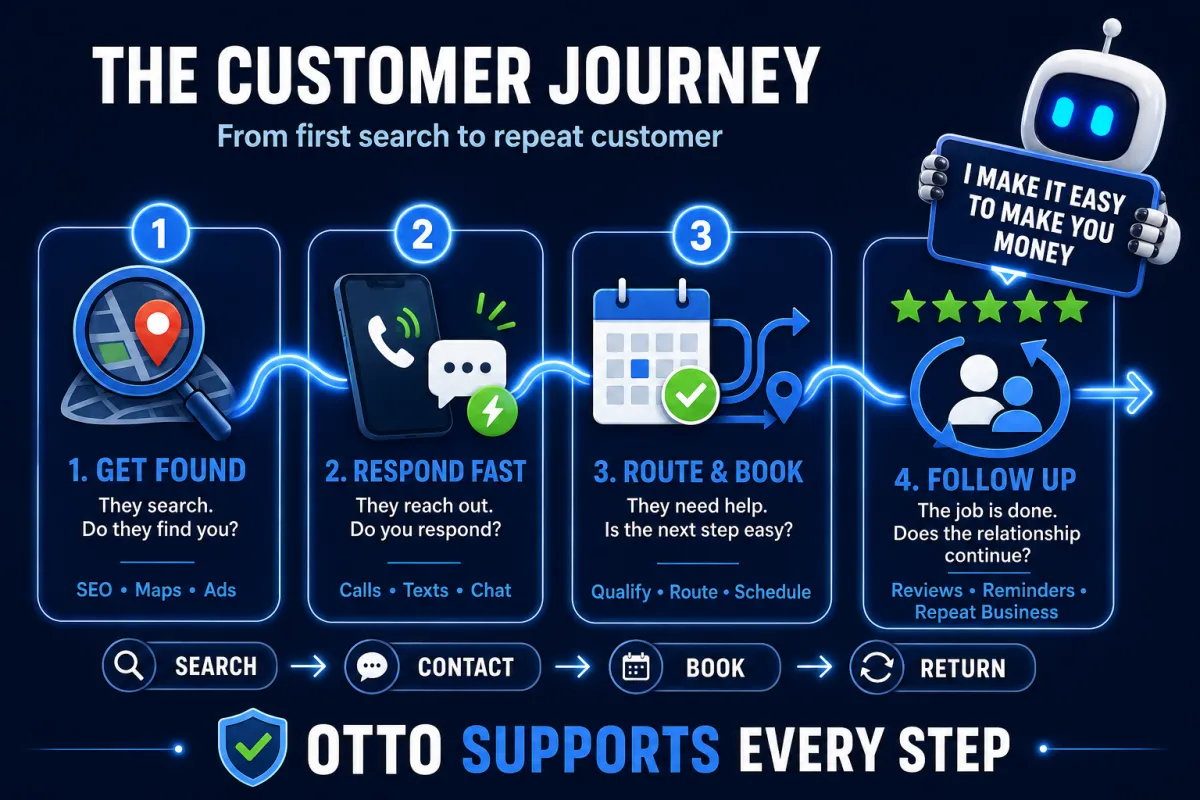
The customer journey should move through four clear stages.
THE SIMPLE FRAMEWORK
Get Found. Respond Fast. Route and Book. Follow Up. One weak step creates a revenue leak. Four strong steps create a dependable growth system.
Start With a Four-Step Revenue Leak Audit
Before buying more ads or adding another marketing platform, review the full path a customer takes through your business. Answer each question with a clear yes or no.
Get Found: Do local customers see your business when they search for your services?
Respond Fast: Does every new lead receive a useful response within seconds?
Route and Book: Does each caller or message reach the right next step without friction?
Follow Up: Do you request reviews, revive old opportunities, and stay connected after the job?
Every no identifies a leak. Fix the earliest leak first, then work through the remaining steps in order.
Step 1: Get Found by Local Customers
The first step sounds obvious, but many home service companies skip it. A customer cannot call a company they never see. Your business needs a visible presence across Google Search, Google Maps, your website, local directories, social platforms, and AI search results.
How to audit your local visibility
Search your main service and city from a private browser window. Look for your company in the map results and regular search results.
Review your Google Business Profile. Confirm your service areas, hours, phone number, categories, photos, and services.
Check your service pages. Each major service needs a clear page that answers common customer questions and gives the visitor one obvious next step.
Review your reputation. Look at your review count, rating, review frequency, and owner responses.
Track every lead source. Record whether each call, form, text, or booking came from SEO, Google LSA, Google Ads, social media, or a referral.
What to fix first
Start with the services that produce the highest job value. Build or improve one focused page for each service. Strengthen your Google Business Profile. Publish useful answers to the questions homeowners ask before booking. Then connect call tracking and form tracking so you know which channels produce real jobs.
If your business already generates steady calls and messages, move to step two. More traffic will not solve a slow-response problem. If visibility remains weak, an AI receptionist for home service businesses works best alongside a strong local marketing foundation.
Step 2: Respond Before the Lead Goes Cold
A new lead often contacts several companies. The first useful response earns the conversation. Set a company standard of answering calls within 15 seconds and replying to digital inquiries within 10 seconds. Treat this as an operating rule, not a suggestion.
How to build a fast-response system
Connect every lead source. Send website forms, website chat, SMS, email, Facebook, Instagram, Google LSA, and paid-ad leads into one managed workflow.
Send an immediate first response. Acknowledge the request, introduce your business, and ask one useful question about the service need.
Follow up more than once. Create a short sequence across text, call, and email for leads who do not answer the first response.
Collect the right details. Ask for the customer name, service address, issue, urgency, preferred timing, and best contact method.
Notify your team. Send a clean summary instead of forcing office staff to search through several inboxes.
Otto Chat handles website chat, SMS, email, social messages, Google LSA, and advertising leads through one trained AI front desk. It responds, gathers details, supports booking, and gives your team context.
Example: A plumbing lead after hours
A homeowner clicks a Google Local Services Ad at 8:30 p.m. because a water heater is leaking. The first plumbing company sends the call to voicemail. The homeowner contacts the next company.
A better system answers immediately, identifies whether water is actively leaking, collects the address, checks the service area, and moves the customer toward the next available appointment. This is the same problem covered in the guide on how to stop missing customer calls as a plumber.
Step 3: Route, Qualify, and Book the Opportunity
Fast response starts the conversation. A strong front desk system moves the conversation forward. It identifies what the customer needs, separates routine work from urgent issues, answers common questions, and creates a clear next step.
Map your five most common customer paths
Most home service companies receive the same core types of calls and messages:
New service request
Urgent or emergency request
Estimate or replacement inquiry
Existing customer question
Billing, rescheduling, or service-status request
Write down the questions, rules, and next step for each path. Decide what your front desk should book, what it should route, what requires a human, and what information your field team needs before arrival.
Build the intake and routing rules
Define your service areas and excluded locations.
List emergency triggers for each service. Examples include active flooding, a burning smell, no cooling during extreme heat, or a garage door stuck open.
Set booking windows by service type, location, technician skill, and urgency.
Create human handoff rules for frustrated customers, complex estimates, commercial accounts, and safety concerns.
Send a complete summary into your CRM, inbox, or dispatch system.
Otto Voice provides 24/7 phone coverage for busy hours, nights, weekends, and holidays. It qualifies callers, checks urgency, supports scheduling, routes calls, and sends clear notes to your team.
For a deeper setup checklist, read the automated phone answering service guide. It explains call types, routing rules, after-hours coverage, and testing before launch.
Step 4: Follow Up After the Job
The customer journey does not end when the technician closes the job. Every completed service creates opportunities for a review, a referral, a maintenance plan, another service, or a future replacement. Without a follow-up system, those opportunities disappear.
Build four follow-up workflows
Post-job check-in. Ask whether the service met expectations and route unhappy customers to your team before requesting a public review.
Review request. Send a direct review link while the positive experience remains fresh. Follow up once when the customer does not respond.
Unsold estimate follow-up. Contact open estimates on a planned schedule and answer questions that delay the decision.
Customer reactivation. Send seasonal reminders, maintenance notices, membership offers, and service messages based on prior work.
This step helps turn one service call into a longer customer relationship. It also creates a steady flow of recent reviews, which supports local trust and improves the first step of the funnel.
How to Install the Four-Step System in 30 Days
Week 1: Measure the leaks
Track calls, forms, chats, texts, bookings, missed calls, and reviews.
Record response times during business hours and after hours.
List every channel where customers contact your business.
Calculate your lead-to-booked-job rate.
Week 2: Fix response and coverage
Set response-time goals.
Create missed-call and after-hours workflows.
Connect website, text, social, email, and advertising leads.
Write the first-response questions for each major service.
Week 3: Build booking and routing
Map common call types.
Define emergency and human handoff rules.
Connect your calendar or scheduling workflow.
Test every path with real phone calls and messages.
Week 4: Add retention workflows
Launch post-job check-ins and review requests.
Create open-estimate follow-up.
Build seasonal reminders and customer reactivation campaigns.
Review results each week and adjust weak steps.
If your team already feels stretched, review how other contractors scale without hiring more office staff. Start with communication automation, then add scheduling, CRM follow-up, and field operations in a logical order.
Track the Numbers That Show Real Growth
Review these numbers every week:
Local search visibility for priority services
Inbound calls and digital leads by source
Average first-response time
Call answer rate
After-hours opportunities captured
Lead-to-booked-job rate
Open estimates recovered
Reviews requested and received
Past customers reactivated
Revenue connected to each source and workflow
Do not judge the system by message volume alone. Track booked work and recovered revenue. A faster response matters because it moves more qualified customers toward the schedule.
Frequently Asked Questions
What is a home service marketing funnel?
A home service marketing funnel is the path a customer follows from finding your business to booking service and returning later. The four practical stages are visibility, response, booking, and follow-up.
Why do home service businesses lose leads?
The most common causes include weak local visibility, missed calls, slow responses, scattered inboxes, poor after-hours coverage, confusing intake, and inconsistent follow-up.
Does an AI receptionist replace office staff?
A trained AI receptionist supports office staff by handling repetitive intake, common questions, lead nurturing, booking support, after-hours coverage, and summaries. Your team stays focused on complex situations and customer relationships.
Which home service businesses benefit from this system?
The framework fits HVAC, plumbing, electrical, roofing, garage door, pool, landscaping, pest control, restoration, locksmith, and other service businesses that depend on calls, messages, appointments, and repeat customers.
Plug the Leaks Before Buying More Leads
More leads will not fix a broken customer journey. Start by making sure customers find you. Respond while their need remains urgent. Give them a clear path to the right appointment. Then follow up after the work.
Ottomatic AI brings voice, chat, text, email, social responses, lead nurturing, booking support, follow-up, and review requests into one system built for home service businesses.
